
Timing matters when buying equipment for an inflatable hire business. A product that arrives before customers begin planning spring and summer events has time to attract bookings. The same product arriving halfway through the busy season may miss many of its strongest earning opportunities.
There is no single month that suits every purchase. A standard bouncy castle may be available relatively quickly, while a customised obstacle course or large multi-part inflatable may take considerably longer to design, manufacture and deliver.
The most reliable approach is to choose when you want the inflatable ready for hire and work backwards from that date.
Begin After the Previous Busy Season
For many UK hire businesses, the planning process should begin when the main summer season starts to slow down.
At this point, recent booking patterns are still easy to review. Check which inflatables were hired most frequently, which dates reached full capacity and which enquiries could not be fulfilled.
Do not rely only on the number of bookings. Look at the reasons customers contacted you. Repeated requests for a particular type of equipment may reveal a gap in your fleet.
For example, you may have received regular enquiries for:
- Low-height inflatables suitable for halls
- Castle-and-slide combinations
- Larger products for school fêtes
- Obstacle courses for older children
- Neutral designs for corporate events
- Compact units for smaller gardens
One unusual request is not necessarily a reason to invest. A pattern of missed bookings is much stronger evidence.
This is also a useful time to inspect existing equipment. A popular inflatable with worn climbing areas, damaged artwork or recurring repairs may need replacing before the next season.
Autumn: Review, Compare and Set a Budget
Autumn is often a practical time to decide what the business needs next.
Begin by separating potential purchases into three categories:
- Replacements for ageing equipment
- Additional units for products that are regularly overbooked
- New product types that could reach a different customer group
Replacement equipment usually deserves priority because it protects existing income. Adding another popular unit may be the next safest investment. A completely new attraction can support growth, but demand may be less predictable.
Your budget should include more than the advertised product price. Allow for shipping, accessories, storage, handling equipment, inspection, marketing and any applicable import charges.
Cash flow is particularly important during the quieter months. A new inflatable should not leave the business without enough working capital for insurance, vehicle costs, repairs and normal operating expenses.
By the end of this stage, you should know what type of inflatable you want, why the business needs it and approximately how much you can invest.
Early Winter: Confirm the Product and Delivery Schedule
Once the type of inflatable has been selected, discuss the details with the manufacturer before committing to an order.
Confirm:
- Overall dimensions
- Recommended user group
- Entrance and exit positions
- Internal activities
- Blower requirements
- Packed dimensions and weight
- Material and construction details
- Included accessories
- Production time
- Available delivery methods
- Expected shipping time
These details determine whether the product suits your customers as well as your daily operations. A large obstacle course may have strong booking potential, but it will not be practical if it cannot fit inside your vehicle or storage area.
If the inflatable will be customised, approve the colour layout, printed artwork and structure carefully. Design changes made after production begins may cause delays or additional costs.
Manufacturers such as East Inflatables can provide dimensions, design information and production details before an order is confirmed. Use this stage to resolve practical questions rather than choosing a product from photographs alone.
Allow More Time for Custom Equipment
Customisation can help a hire company offer something that local competitors do not have, but it requires a longer and more careful approval process.
The final design should be checked for more than visual appeal. Consider whether printed panels will remain suitable for several seasons and whether a highly specific theme could limit the range of customers willing to hire it.
Neutral or adaptable designs can often serve birthdays, schools, community organisations and corporate events. Strong character-based themes may appeal to a narrower market and can become dated more quickly.
Large custom inflatables may also require several sections, additional blowers or more staff during installation. These operational requirements should be understood before production starts.
The more complex the product, the earlier it should be ordered.
Plan Backwards From the First Booking
Suppose you want a new inflatable ready to hire at the beginning of April. It would be risky to schedule delivery for the final week of March.
The inflatable needs to arrive early enough for you to:
- Inspect the packaging and equipment
- Fully inflate and test the product
- Check the blower and accessories
- Train staff on setup and packing
- Take original photographs
- Add the product to your website
- Contact previous customers
- Leave time for unexpected issues
A more practical target would be to have the equipment ready several weeks before its first advertised booking date.
The exact order date depends on current production and shipping schedules. Ask for realistic time ranges and include a contingency period rather than planning around the fastest possible estimate.
January and February: Prepare for Early Enquiries
Customers do not always wait for warm weather before arranging spring and summer events.
Schools, companies, charities and community organisations may confirm their event suppliers several months in advance. If your new inflatable is not visible when they start searching, another operator may secure the booking.
Once the design and delivery schedule are confirmed, you can begin preparing:
- Product descriptions
- Hire prices
- Venue requirements
- Promotional photographs or approved design images
- Social media announcements
- Messages for previous event customers
You may advertise that a new attraction is coming soon, but avoid accepting bookings too close to the estimated delivery date. Transport delays can occur, and the product still needs to be inspected after arrival.
The first confirmed booking should leave a reasonable margin between delivery and use.
March and Early Spring: Test Before Promoting Heavily
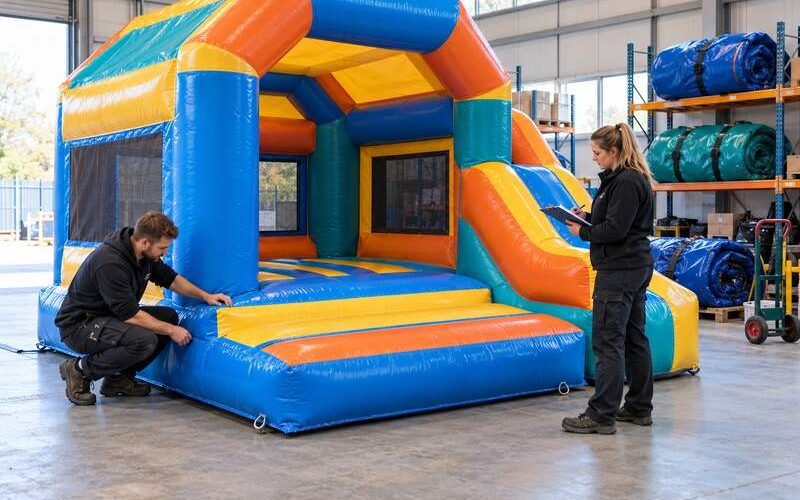
When the inflatable arrives, check it under normal operating conditions before it enters the hire fleet.
Fully inflate the product and inspect its overall shape, seams, netting, anchor points, climbing features, slide surface, inflation tubes and accessories. Confirm that the product dimensions and blower requirements match the agreed information.
This is also the right time to practise:
- Unloading
- Positioning
- Inflation
- Anchoring
- Supervision arrangements
- Deflation
- Rolling
- Reloading
A product that appears manageable in photographs may require more time or staff than expected. A practice setup allows you to calculate realistic labour requirements before quoting customers.
Take your own photographs once the equipment is ready. Original images make the product page more credible and show customers exactly what they will receive.
Buying During the Busy Season
Purchasing in spring or summer is not always a mistake. It can be justified when current enquiries show clear demand.
For example, you may discover that a particular castle-and-slide combination is fully booked every weekend, or that several schools have requested an obstacle course you do not own.
Before ordering urgently, calculate how many bookings the inflatable is realistically likely to secure during the remaining season. Then compare that income with any additional cost for faster shipping.
Paying more for urgent delivery may make sense if several profitable bookings are already available. It is less attractive when the purchase is based only on the hope of finding customers after the product arrives.
If the equipment will remain valuable for future seasons, using a slower and more economical delivery method may produce a stronger long-term return.
When to Replace Rather Than Repair
An older inflatable should not automatically be replaced because it has visible wear. Many issues can be repaired, and a well-maintained product may continue to generate reliable bookings.
Replacement becomes more reasonable when:
- Repairs are becoming frequent
- Appearance is affecting customer interest
- The product regularly loses pressure
- Important areas show extensive wear
- Downtime is causing lost bookings
- The design no longer suits current demand
- Repair costs are approaching the value of the equipment
Inspecting older units after the busy season gives you time to make this decision calmly. Waiting until a product fails during summer can lead to cancelled bookings and an expensive emergency purchase.
Where possible, keep the older unit available until the replacement has arrived and passed inspection.
A Final Check Before Placing the Order
Before paying a deposit, make sure you can answer each of these questions:
- What customer demand does this inflatable meet?
- How many suitable venues are available locally?
- Can the equipment fit inside the current vehicle?
- Is there enough dry storage space?
- How many people are needed to handle it?
- What hire price can the local market support?
- How many bookings are required to recover the investment?
- When must it arrive to be ready for the intended season?
- Is there enough contingency time for delays?
- Will the business retain sufficient working capital?
If several answers remain unclear, the purchase may need more research.
The Practical Buying Window
For many UK inflatable hire businesses, the strongest buying process begins in autumn and continues through early winter. This provides time to review summer demand, select suitable equipment, arrange production and prepare marketing before spring enquiries increase.
That does not mean every inflatable must be ordered during the same period. Standard products, custom designs and large multi-section units all require different schedules. Business finances and storage capacity may also affect the decision.
Choose a target date when the product should begin earning income, then work backwards through delivery, production and approval. Add time for inspection, staff training, photography and promotion.
The right purchase is not simply made at the lowest price or during a particular month. It is made early enough to enter the fleet properly, supported by evidence of demand and without placing unnecessary pressure on the business.