
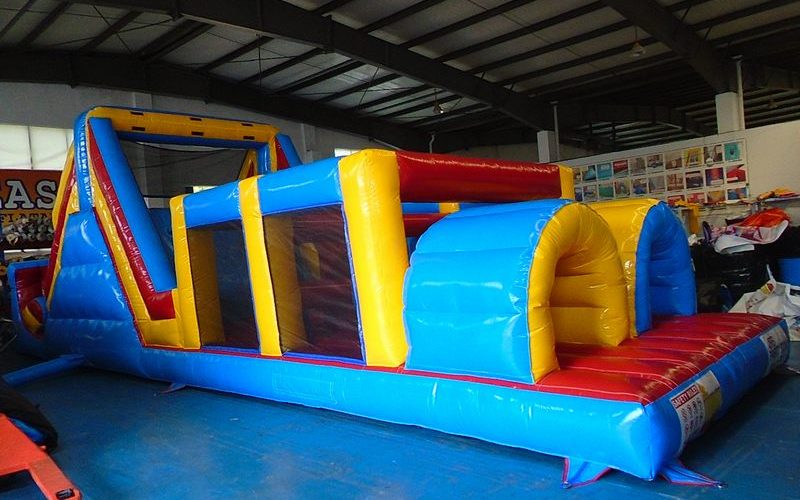
Inflatable obstacle courses stand out at school fêtes, community events, corporate family days and larger celebrations. Unlike a standard bouncy castle, they give users a clear route to follow, combining tunnels, climbing sections, obstacles and slides in a single attraction.
For a hire business, however, an obstacle course is usually a more substantial investment than a conventional bouncy castle. It may require more storage space, additional transport capacity and a larger setup area. Before adding one to your fleet, it is important to consider whether the likely demand and booking value justify the cost.
This guide looks at the commercial advantages, practical limitations and key buying decisions involved.
Why Are Inflatable Obstacle Courses Popular?
A bouncy castle mainly offers open bouncing space. An obstacle course creates a more structured experience, encouraging users to move through several activities before reaching the exit.
Depending on the design, the course may include:
- Entrance tunnels
- Inflatable barriers
- Pop-up obstacles
- Climbing walls
- Crawl-through sections
- Slides
- Single or dual racing lanes
This variety can hold users’ attention for longer and makes the attraction visually appealing at larger events. A dual-lane design can also introduce a competitive element, allowing two participants to race side by side.
Because obstacle courses suit both casual play and organised challenges, they can appeal to schools, clubs, companies and community event organisers as well as families.
Can an Obstacle Course Expand Your Customer Base?
One of the strongest reasons to add an obstacle course is its ability to serve events that may be less suitable for a standard children’s bouncy castle.
Potential booking opportunities include:
- School fêtes and sports days
- Community fun days
- Charity fundraisers
- Corporate family events
- Holiday clubs
- Youth group activities
- Festivals and village celebrations
- Larger private parties
These events often have more guests, longer operating periods and larger budgets than a typical garden birthday party.
An obstacle course may therefore help a hire company move beyond smaller private bookings and compete for higher-value event work. However, this advantage only applies if there is enough demand in the area you serve.
Single-Lane or Dual-Lane: Which Is Better?
Single-lane obstacle courses are often narrower, lighter and easier to fit into restricted spaces. They may be suitable for operators who want to introduce a new product category without immediately purchasing one of the largest models.
Dual-lane courses offer a stronger racing experience and can process participants more efficiently. They are particularly attractive for school events, team activities and busy public events where queue management matters.
The trade-off is that dual-lane models are generally wider, heavier and more expensive. They may also need more attendants and a larger setup area.
Before choosing, consider the types of bookings you already receive. A compact single-lane course may be more practical for private parties, while a dual-lane model could be a better fit for an operator targeting schools and large community events.
Does a Longer Course Always Offer Better Value?
A longer obstacle course can look impressive, but length alone does not determine its commercial value.
Very large courses may attract attention, yet they can also limit the number of venues where the equipment can be used. A long unit may not fit in smaller gardens, community halls or restricted school grounds.
The design of the activity route matters just as much as the overall length. A shorter course with varied obstacles, a climbing section and a finishing slide may provide a more engaging experience than a longer design with large areas of unused space.
When comparing models, look at:
- The variety of activities
- The width of the lanes
- The height of the climbing section
- The visibility of users inside the course
- The position of the entrance and exit
- The number of suitable venues in your area
The best investment is not necessarily the largest course. It is the one that can be hired regularly.
Can an Obstacle Course Improve Event Capacity?
At a busy event, an attraction needs to keep users moving safely. An obstacle course naturally creates a route from the entrance to the exit, which may make participant flow easier to manage than on an open bouncing area.
A well-planned course can allow one group to enter while another progresses through the obstacles. Dual-lane models may improve this flow further by allowing users to move through the attraction side by side.
Actual capacity will depend on the design, user ages, manufacturer’s instructions and supervision arrangements. Operators should never exceed the stated user limit in an attempt to shorten queues.
For event organisers, predictable participant flow can be a significant advantage. It may make an obstacle course especially useful at school fêtes, community events and corporate family days.
Can It Increase the Value of a Booking?
Obstacle courses are usually larger and offer more activities than standard bouncy castles, so hire companies may be able to charge a higher booking price.
They can also form part of a larger event package. For example, an operator might combine an obstacle course with:
- A smaller bouncy castle for younger children
- An inflatable slide
- An interactive game
- A sports-themed attraction
- Additional event equipment
This can increase the total value of a booking without relying only on a single inflatable.
However, a higher hire price does not automatically mean a higher profit. Fuel, staffing, setup time, storage and maintenance should all be included when calculating the likely return.
Is a Modular Obstacle Course Worth Considering?
Some obstacle courses are designed as separate sections that can be joined together. A modular system may include an entrance section, central obstacle section and finishing slide.
This arrangement can give a hire business more flexibility. Individual sections may be used for smaller venues, while the complete course can be offered for larger events.
A modular design may also be easier to transport and handle than one very large inflatable. If a section requires maintenance, the remaining sections may still be available for certain bookings.
Before purchasing a modular system, check:
- How the sections connect
- Whether each section can operate independently
- How many blowers are required
- Whether the colours and dimensions align correctly
- How much space the complete layout needs
- Whether separate sections remain attractive when used alone
Modularity is most valuable when it creates genuinely useful booking options rather than simply dividing one large course into several heavy pieces.
What Practical Challenges Should You Consider?
Obstacle courses can generate valuable bookings, but they also introduce practical demands.
Transport
A large commercial obstacle course may require more vehicle space than a standard bouncy castle. Some units are divided into sections, while others are packed as one heavy roll.
Check the packed dimensions and weight before buying. Make sure your existing van, trailer and handling equipment are suitable.
Storage
The packed inflatable, blowers, ground sheets, stakes, mats and other accessories all need dry and secure storage.
Allow space for the equipment to be unrolled for inspection, cleaning and repairs. A storage area that is already close to capacity may need to be reorganised before a large obstacle course is added.
Setup Area
The listed product dimensions are not the same as the total operating area. Additional clearance may be required for anchoring, blowers, entrance mats, supervision and safe movement around the inflatable.
Large courses may be unsuitable for many residential gardens, so consider how many of your existing customers have access to appropriate venues.
Staffing
A larger unit may require more than one person to unload, position, install and pack away. Busy events may also require additional attendants.
If every booking creates extra labour costs, those costs should be reflected in the hire price.
Cleaning and Inspection
Obstacle courses contain more internal features than a simple bouncy castle. Tunnels, barriers, climbing areas and slide surfaces may take longer to inspect and clean.
The maintenance schedule should account for stitching, netting, internal obstacles, connections and high-wear areas.
When Might an Obstacle Course Be a Poor Investment?
An obstacle course may not be the right next purchase if most of your bookings involve small gardens, low indoor venues or very young children.
It may also be unsuitable if:
- Your vehicle cannot transport it safely
- Your storage area is already full
- You do not have enough staff for handling and setup
- Local customers mainly request low-cost party packages
- Suitable venues are limited
- Similar products are already widely available from nearby competitors
In these circumstances, a smaller combo unit, compact slide or interactive game might produce more frequent bookings with fewer operational difficulties.
The aim is not to own the most impressive inflatable. It is to invest in equipment that matches your market and resources.
How Can You Check Demand Before Buying?
Before placing an order, review your previous enquiries. Look for customers who requested larger inflatables, racing activities or equipment suitable for schools and public events.
You can also:
- Ask existing school and community clients what they normally hire
- Review the equipment offered by local competitors
- Check which local venues have enough space
- Record enquiries you could not fulfil
- Compare expected hire prices in your service area
- Speak to previous customers who organise annual events
Seasonal patterns matter as well. A course purchased after the busiest period may remain unused for several months, while buying before the main event season could allow it to begin generating income sooner.
Demand should be based on realistic local evidence rather than the visual appeal of the product alone.
How Many Bookings Are Needed to Recover the Investment?
A simple payback calculation can help determine whether the purchase is commercially realistic.
Divide the total investment by the estimated profit from each booking. Include the purchase price, shipping, accessories and any extra equipment required to handle or store the inflatable.
For example, if the total investment is £4,000 and the estimated profit after direct booking costs is £200, approximately 20 bookings would be required to recover the investment.
This is only a basic estimate. It does not include every long-term business expense, but it provides a useful starting point.
Use conservative figures rather than assuming that every enquiry will become a confirmed booking. It is better to calculate the return using a realistic annual booking volume.
Final Verdict
An inflatable obstacle course can be a worthwhile addition for a hire company that already serves schools, community events, corporate family days and larger private celebrations.
It can broaden the range of events you can serve, support higher-value bookings and give customers an attraction that feels more active and competitive than a standard bouncy castle.
However, its value depends on more than appearance. The course must suit your customers, vehicle, storage space, staffing and local venues. A large product that receives only occasional bookings may offer a weaker return than a smaller model that can be hired regularly.
Before buying, compare the expected demand, operating costs and likely profit per booking. If the figures are realistic and the product fills a clear gap in your fleet, an obstacle course can become one of your most versatile event attractions.